Synthetic versus natural pigments: hidden risks for longevity
For archival oil painting, the label “natural” does not settle the durability question. Natural earth pigments such as yellow ochre, PY43, are mineral mixtures; synthetic iron oxides such as PY42 are more uniform and typically have finer particles.
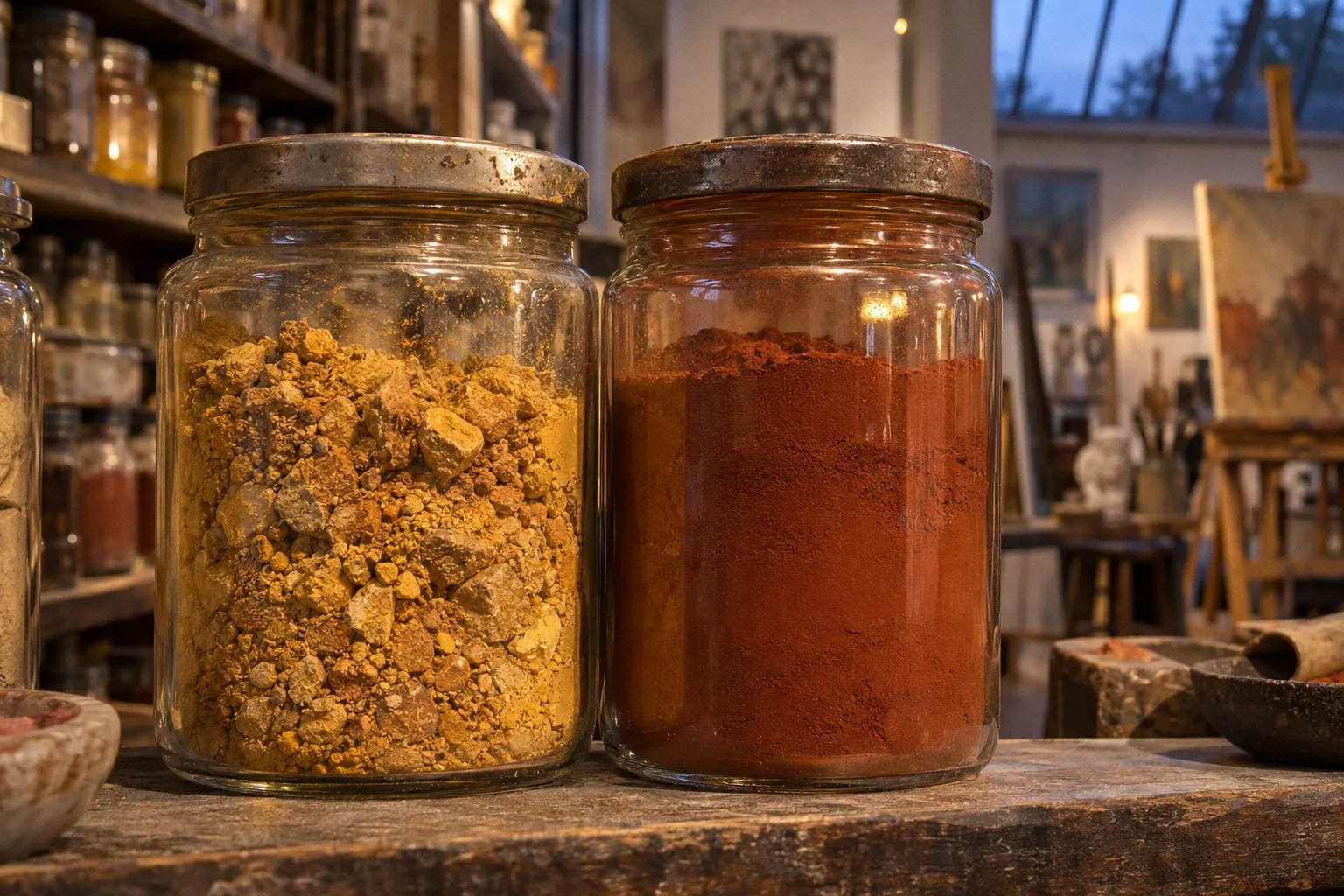
Those differences affect tinting strength, handling, and consistency. They do not establish a simple hierarchy of permanence.
The practical question behind synthetic pigment vs natural earth pigment durability is narrower: which pigment is actually in the paint, how does it behave in your mixture, and what evidence supports its lightfastness? I treat origin as one data point, not an archival rating. A pigment’s Colour Index identity is more useful than a marketing phrase, but it still does not tell the whole story of the paint film.
Natural earth pigments are mineral systems, not single ingredients
Natural yellow ochre is commonly identified as PY43 and associated with goethite. That label points to a pigment family, not a chemically pure, identical batch. Earth pigments can also contain clay minerals, silica such as quartz, manganese oxides, calcium carbonate, and other iron-bearing minerals. The proportions vary with the source and processing.
That complexity has visible and practical consequences. Particle size and mineral content influence how a pigment disperses, how much texture it contributes, and how it sits in an oil film. Two ochres sold under the same broad name can therefore differ in undertone, granularity, opacity, and tinting behavior. “Natural earth” describes origin; it does not guarantee a fixed handling profile.
For the painter, variation is not automatically a defect. A granular earth can be useful when a passage needs a subdued tinting strength or a surface that does not look mechanically uniform. But variation complicates repeatability. If a particular mixture is central to a painting or a series, record the manufacturer, pigment code, and batch where available. A tube name alone may not be enough to reproduce the result years later.
Natural earth pigments are often associated with high lightfastness. That reputation should not be stretched into the claim that every natural pigment is more permanent than every synthetic one. The mineral character of an earth pigment and its track record may make it a sound archival choice, but permanence still depends on the actual pigment composition and the conditions of use.
Synthetic iron oxides: more uniform, often stronger in tint
Synthetic iron oxides are identified by codes including PY42 for yellow iron oxide and PR101 for red iron oxide. Their natural counterparts include PY43, natural yellow ochre, and PR102, natural red ochre. Synthetic Mars pigments were first created in the 18th century and became widely popular as alternatives to natural earth pigments in the early 20th century.
Compared with natural earth pigments, synthetic iron oxides generally have smaller particles. That tends to increase tinting strength and staining behavior. In practical terms, a small addition may shift a mixture more decisively, and a strong stain can be harder to lift or neutralize once it has spread through a passage. Exact handling varies by paint formulation, so the pigment code is a starting point, not a substitute for a controlled test.
| Property | Natural earth pigment | Synthetic iron oxide |
|---|---|---|
| Example code | PY43 yellow ochre; PR102 red ochre | PY42 yellow iron oxide; PR101 red iron oxide |
| Composition | Mineral mixture; may include clay, silica, manganese oxides, or calcium carbonate | More controlled iron-oxide pigment composition |
| Particle behavior | Often more granular and variable between batches | Generally finer and more uniform |
| Tinting strength | Often less forceful, but varies | Generally higher |
| Handling implication | Can support muted mixtures and visible texture | Can shift mixtures strongly and stain more |
| Archival implication | Often highly lightfast; not automatically superior | Synthetic origin alone does not imply poor permanence |
For oil painting, this distinction matters most when a color is used in a thin glaze, a pale mixture, or a passage that must be matched later. A finer, stronger pigment can dominate a mixture even at low concentration. A more granular earth may disperse differently and leave a less uniform surface. Neither outcome is inherently better; the cost is control. If the working method depends on repeatable color, consistency has direct value. If the method benefits from mineral variation, a natural earth may be the better fit.
A pigment’s origin predicts some handling traits. It does not, by itself, predict the lifespan of the painting.
Batch consistency is an archival issue too
Pigment stability is not only about whether a color fades under light. It is also about whether the tube contains what its label leads the painter to expect. Natural sources vary, and some industrial suppliers have reportedly added synthetic iron oxides or other pigments to natural batches to correct color variation. Such adjustments may not be disclosed to paint manufacturers.
That possibility does not mean every natural-earth paint is adulterated. It means that “natural” should not be treated as a precise compositional guarantee. If a manufacturer provides a Colour Index code and meaningful pigment information, that is more useful than a broad name such as “ochre” or “earth red.” If the composition is not disclosed, the uncertainty remains. Do not fill the gap with assumptions about purity or permanence.
For a studio that needs reliable repeats, I would assess paint in three layers:
- Identity: Is the Colour Index code given? PY43 and PY42 are not interchangeable labels, even when both paints are sold as yellow ochre.
- Behavior: Does the paint have the tinting strength, transparency, and texture the passage requires? A small drawdown or test mixture can expose differences before they reach the finished work.
- Documentation: Can the paint be identified again by brand, line, code, and batch? Keep that information with the painting record if future retouching or reconstruction is plausible.
This is a more useful basis for choosing pigments for archival painting than a natural-versus-synthetic rule. It also keeps a common studio problem in view: a supposedly stable color that cannot be recreated because its exact composition or source was never recorded.
Synthetic pigments are not one stability class
“Synthetic” covers chemically different pigment families. Synthetic iron oxides are inorganic pigments; synthetic organic pigments are another category, with different structures and performance profiles. Treating all of them as a single risk group is not technically sound.
The history itself shows why the category is broad. Alizarin Crimson, the first synthetic organic pigment made to imitate a natural chemical composition, was synthesized in 1869. Arylide yellow was introduced in 1919. These dates establish the development of particular pigment families; they do not provide a blanket durability rating for every modern synthetic color.
The key distinction is between chemical identity and marketing category. A synthetic iron oxide may offer strong, consistent color and high permanence. Some synthetic organic pigments are highly useful, but their lightfastness cannot be inferred simply from the fact that they are synthetic. The exact pigment matters. So do the formulation and the exposure conditions. There is no defensible universal timeline for how long every synthetic organic pigment will retain its original appearance under all museum or domestic lighting.
For the same reason, “natural” is not a shortcut around pigment-specific information. Natural organic lakes, for example, should not be grouped with durable mineral earths merely because both have natural origins. Likewise, synthetic iron oxides should not be treated as equivalent to every synthetic organic pigment. For artist grade paint pigment longevity, the relevant comparison is pigment against pigment, not natural against synthetic as broad labels.
A selection route for archival oil painting
When I evaluate a pigment for a painting expected to last, I separate the decision into performance requirements. This avoids paying for a label while overlooking the behavior that will determine whether the paint is usable in the passage.
1. Start with the Colour Index code. Compare PY43 with PY42, or PR102 with PR101, rather than relying only on the commercial color name. The code narrows the identity, although it does not disclose every detail of the paint formulation.
2. Match tinting strength to the task. A more forceful synthetic iron oxide can be efficient in a mixture, but it also gives less room for casual adjustment. A more variable earth pigment may require a fresh test when a new batch is opened.
3. Check opacity and surface behavior in the intended film. A pigment’s handling in a thick opaque passage may not predict its appearance in a thin glaze. Test it in the application you plan to use, with the same medium and approximate film thickness.
4. Read lightfastness information at pigment level. Do not infer permanence from the words “traditional,” “natural,” or “modern.” If the manufacturer gives no usable pigment-specific information, treat that absence as an unknown rather than a favorable result.
5. Keep a record of the working mixture. Note the pigments, proportions in practical terms, medium, and brand. Exact laboratory precision is not necessary for every painting, but enough detail should remain to reconstruct the color family later.
This route is deliberately conservative. It does not claim that every paint requires formal testing or that a painter can predict decades of aging from a studio drawdown. A swatch can reveal present-day opacity, tinting strength, and handling. It cannot replace pigment-specific lightfastness evidence or guarantee the behavior of every finished oil film.
The main oil painting pigment stability issues are often framed too narrowly as fading. In practice, a painter also has to manage mixture control, batch variation, and the gap between a color name and its composition. A pigment may be permanent yet inconvenient to reproduce. Another may be easy to match but unsuitable for a specific light-sensitive application. Those are separate performance questions.
The verdict: buy the pigment, not the origin story
Natural earth pigments such as PY43 and PR102 offer mineral complexity, often high lightfastness, and a handling profile shaped by their particle mix. Synthetic iron oxides such as PY42 and PR101 generally offer greater uniformity and stronger tinting behavior. Neither set wins every archival comparison. Synthetic origin is not a warning label; natural origin is not a guarantee.
For a studio budget, the best value is a pigment with an identifiable composition, suitable lightfastness information, and behavior that fits the layer being painted. Pay for consistency when the painting depends on repeatable mixtures. Choose a natural earth when its granularity, subdued tinting, or specific handling is useful—not because “natural” sounds safer. The decisive evidence is pigment identity and performance, not the story printed on the tube.