Fat over lean versus alla prima: two paths to oil painting
The choice between fat over lean and alla prima is not a choice between two recipes for the same layer structure. One is a rule for building an oil painting across drying stages; the other is a way to finish the work while the paint is still wet.
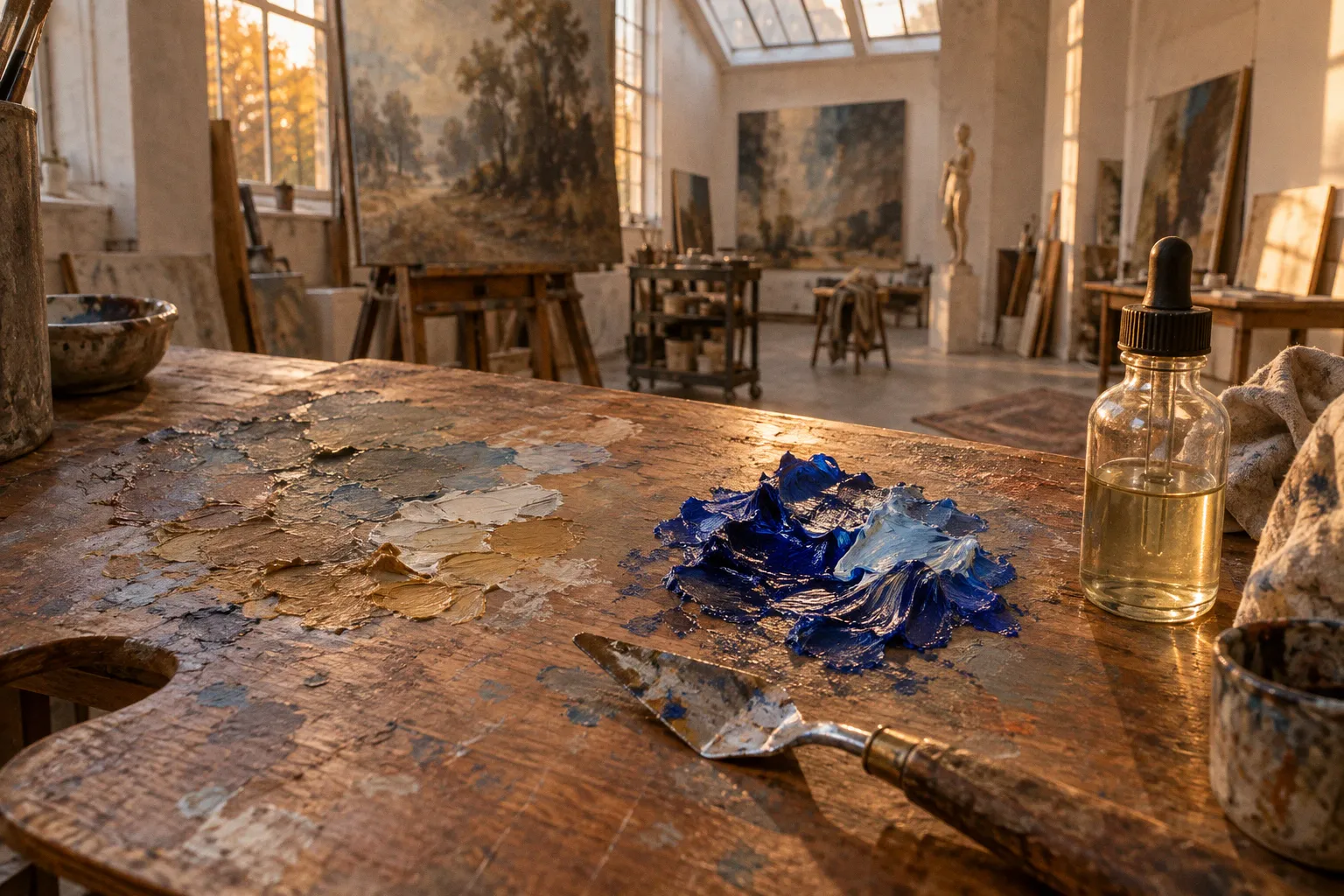
Confuse them, and medium ratios become busywork—or a real structural problem.
For the studio, the distinction has practical costs. Layered painting requires time between applications, sometimes days to weeks. Alla prima concentrates the work into one session, but demands control of paint handling before the surface sets. The useful question is not which method is superior. It is whether the painting’s structure, schedule and handling requirements fit the method.
Fat over lean: a rule for separate drying layers
In a layered oil painting, each new layer should contain a higher proportion of oil than the one beneath it. This is the fat-over-lean rule. Its purpose is mechanical: upper layers remain more flexible as the paint film cures, while lower, leaner layers dry faster and are less flexible. If a relatively rigid layer sits over a more flexible one, movement in the underlying film can contribute to cracking.
“Fat” does not mean thickly applied paint. It refers to oil content. A thin glaze can be fat if it contains a greater proportion of oil; a thick application can still be lean if it has been reduced with solvent. Thickness, pigment load and medium composition affect handling in different ways. Treating them as interchangeable makes the rule hard to apply correctly.
Solvent such as odourless mineral spirits or turpentine reduces the oil content of paint, making a mixture leaner and generally faster-drying. Adding linseed, stand or poppy oil increases its oil content, making it fatter and generally slower-drying. The working sequence moves in one direction:
- Underlayer: relatively lean, with less added oil and, if used, more solvent.
- Middle layers: a higher oil proportion than the underlayer.
- Upper layers or glazes: the highest oil proportion in the sequence.
The rule applies across distinct layers, not to every brushstroke. If a painting is built through separate sessions, the painter has to manage the relationship between a new layer and the one already in place. Those intervals take time: distinct oil-paint layers may need days to weeks of drying before the next stage.
Fat over lean is about the order of flexibility in the paint film—not about making every later passage thicker.
That distinction matters when assessing cracking risk. Fat over lean is a practical structural principle, not a guarantee against every failure. It addresses one relationship in a layered film. It does not compensate for poor support preparation, unsuitable handling or every variable in drying. Nor does the available guidance support assigning a universal curing time in months to a particular pigment under all studio conditions. Pigments and environment vary; a fixed calendar promise would be false precision.
Alla prima: one wet film, one session
Alla prima—also called wet-into-wet or direct painting—means completing the work in one session, before the paint dries. New strokes are placed into wet paint. The layers can merge and dry together as one continuous paint film, rather than forming a sequence of separately dried films.
That changes the structural problem. In true alla prima, the painter is not stacking a lean underlayer, waiting for it to dry, and then placing a fatter layer over it. The whole work is completed while wet. Strict fat-over-lean progression between dried layers therefore does not apply.
This does not mean medium choice stops mattering. Oil, solvent and paint consistency still affect viscosity, drag, opacity and drying behaviour. But those are handling decisions within a wet session, not a requirement to establish a fat-over-lean ladder between each wet stroke. Applying that rule to every passage in alla prima mistakes the method’s structure.
Alla prima’s chief benefit is compressed production time: the painting is completed in one session instead of being built through separate drying stages. That efficiency has a constraint. Decisions have to be made while the surface remains workable. Wet passages can mix where they meet; a painter seeking crisp separation or controlled glazes may find that a single-session workflow offers less control than a staged one.
| Studio requirement | Fat over lean | Alla prima |
|---|---|---|
| Basic structure | Multiple layers applied across drying stages | Work completed while the paint remains wet |
| Medium progression | Each successive layer has a higher oil proportion | No strict progression between wet strokes |
| Drying schedule | Days to weeks between distinct layers may be needed | One session for a true alla prima painting |
| Main structural concern | Maintaining flexibility across the layered film | Managing wet paint interaction and completing the work before it dries |
| Best fit | Deliberate, staged construction and glazes | Direct handling and a concentrated session |
Medium ratios: a starting sequence, not a universal formula
A practical example for layered work uses increasing stand-oil-to-solvent ratios: 1:3 for an underlayer, 1:2 for a middle layer, and 1:1 for a top layer or glaze. The progression illustrates the principle: each stage contains relatively more oil than the one below it.
It is a reference sequence, not an instruction to pour those proportions into every painting. A medium ratio only describes the medium mixture. It does not capture every variable in the paint itself, the pigment, the amount of mixture applied or the required surface effect. A painter should use it to understand direction of travel—leaner below, fatter above—not as a substitute for observing how a specific material behaves.
The practical workflow is straightforward:
1. Decide whether the painting will be layered or wet-into-wet. If it is alla prima, there is no reason to impose a progression intended for separately dried layers.
2. For a layered painting, keep the lower stages leaner. Solvent can reduce oil content; avoid treating extra paint thickness as a way to make a layer “fat.”
3. Increase the oil proportion in successive stages. A sequence such as 1:3, 1:2, then 1:1 makes the change explicit.
4. Allow distinct layers to dry before building on them. The interval may be days to weeks; a fixed, universal wait time is not established by the available facts.
5. Keep the goal in view. A glaze, a broad underpainting and a direct passage have different handling needs. The ratio should serve the layer structure, not become a ritual detached from it.
The cost of a layered approach is partly time. Each new stage depends on the condition of the previous one, and that can extend the painting schedule. The benefit is control over sequential construction: the artist can establish an underlayer, let it dry, and then build further without forcing all decisions into a single wet session.
Why the rule does not transfer to wet-into-wet painting
The phrase “fat over lean” can sound like a rule for every application of oil paint. It is not. Its structural logic concerns layers that dry at different times. In alla prima, the work is completed before the paint dries, and the wet layers dry together as a unified film.
So the distinction is not simply “slow method” versus “fast method.” It is separate films versus one wet working structure. If a painter applies a solvent-rich passage, lets it dry, then returns later with a more oil-rich layer, the fat-over-lean principle is relevant. If the painter completes the painting in one continuous wet session, the same interlayer progression is not the governing issue.
This also clarifies what not to infer. Painting straight from the tube does not automatically violate fat over lean when no solvent-rich underlayers have been used. Likewise, adding oil to every later stroke of a single alla prima session is not required by the rule. The relevant question is whether the work has been divided into distinct drying layers.
If the paint has not formed separate dried layers, fat over lean is not the problem you are solving.
That is useful when choosing a workflow. Do not add medium just to satisfy a rule that does not apply to the painting’s structure. Extra oil changes handling and drying; it is not a neutral compliance measure.
Alkyd mediums: faster drying, simpler scheduling
Alkyd-based mediums such as Galkyd or Liquin can speed drying while increasing flexibility in the paint film. In layered work, that combination may make it easier to manage a fat-over-lean progression across multiple sessions. It can reduce the waiting burden, but it does not erase the need to understand the sequence.
An alkyd medium is not a reason to abandon layer planning. The painter still has to distinguish a wet passage from a dried layer, and still needs a sensible progression when building one stage over another. Faster drying changes the schedule; it does not make all layers structurally interchangeable.
For a studio budget, the trade-off is direct:
- Without an alkyd medium: the workflow relies on the paint and chosen oil or solvent mixture, with potentially longer intervals between stages.
- With an alkyd medium: drying can be faster, and the layered progression may be easier to schedule, but handling and film properties still need to suit the work.
- In alla prima: the central constraint remains the wet session. A medium may change viscosity or drying behaviour, but it does not turn a one-session painting into a multi-stage fat-over-lean structure.
Choose by structure, not by slogan
For deliberate indirect painting, fat over lean is the more useful framework. It organizes separate layers by oil content and flexibility, with a leaner foundation and progressively fatter stages above it. The price is time: distinct layers may require days to weeks before the next application.
For direct painting, alla prima is the cleaner fit. It keeps the work within one session and avoids a formal fat-over-lean progression between dried layers. The trade-off is concentrated decision-making and less separation between passages while the paint remains wet.
My verdict is functional, not aesthetic. Use fat over lean when the painting is built in stages; use alla prima when the aim is to complete a unified wet film in one sitting. The rule has value where its structure applies. Outside that structure, it adds medium management without solving the actual problem.