Broken Art: What Florence’s New Exhibition Reveals About Material Failure
The Art Newspaper reports that Palazzo Strozzi in Florence, working with the National Gallery of Art in Washington, DC, is opening "Broken," an exhibition built around damaged and fragmented historical works.
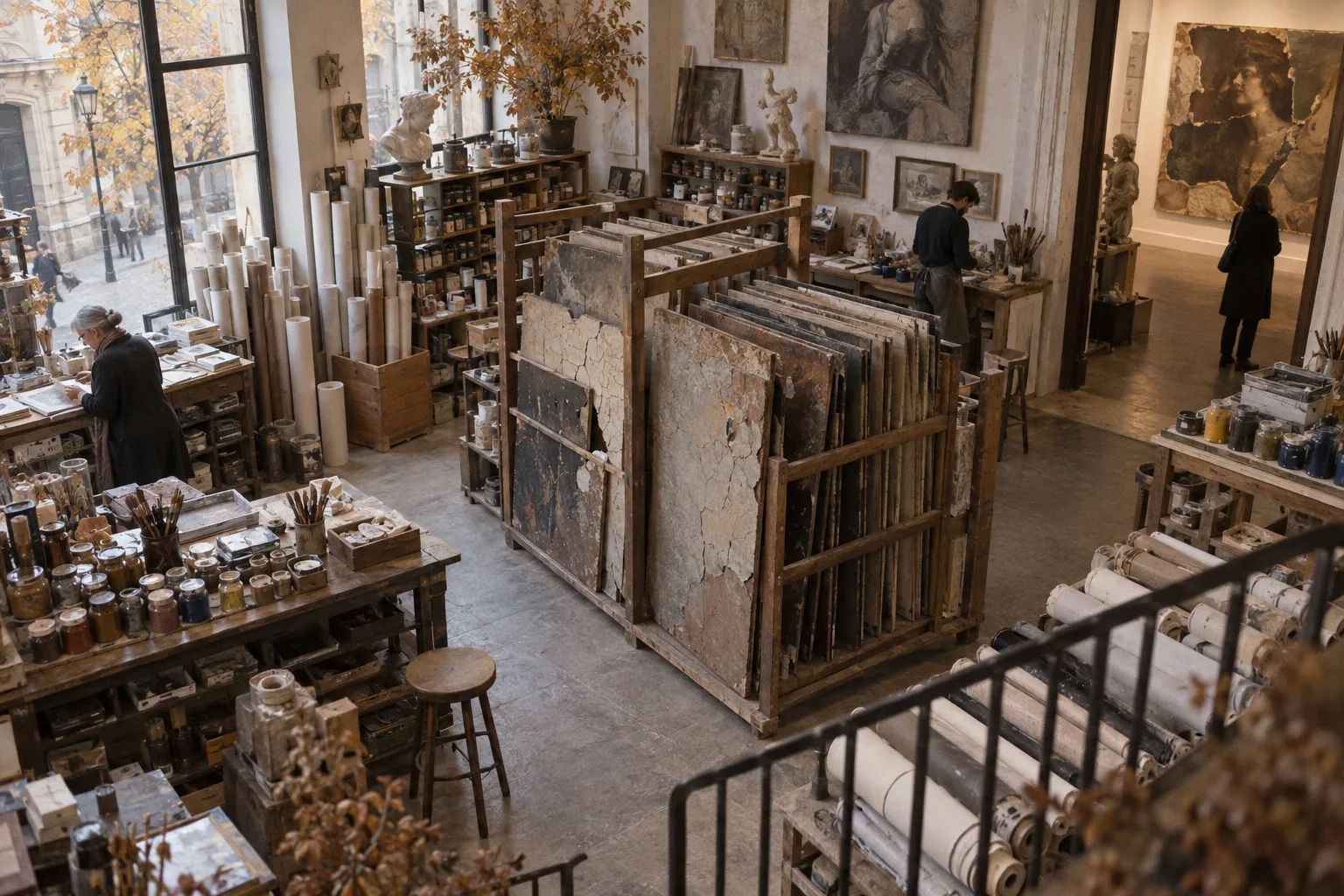
For contemporary studio practice, the premise matters less than the access it offers: recovered fragments function as material case studies, showing how grounds, binders, and pigments behave across centuries of substrate failure. The skeptical question worth asking is whether the exhibition treats damage as data or as decorative pathos.
Scope and Stated Premise
The show pulls objects spanning more than 4,500 years of global production, per the announcement. It frames three intersecting lines: technical conservation, aesthetic value, and the historical narratives attached to what survives. Read as a curatorial brief, that is ambitious scope. Read as a studio brief, it is essentially a long-term materials test — one nobody ran on purpose and where the results cannot be falsified. The two-host model, with Palazzo Strozzi pairing Washington's National Gallery of Art, signals a shared curatorial thesis rather than a standard traveling loan. For viewers, that means selection logic, conservation framing, and wall-text approach come from a single editorial direction applied across both institutions' holdings.
Why It Matters at the Easel
Every painter eventually meets a substrate that cracks, lifts, chalks, or delaminates. Standard museum framing treats damage as loss. This exhibition, on paper, positions damage as evidence. Visitors with a working studio background can extract direct observations: how oil-ground interfaces behave under thermal and mechanical stress, where gesso failures cluster on a panel, which pigments retain opacity versus which powder out and migrate into adjacent layers. That is technical information rarely compiled in one room.
The Washington collaboration also implies cross-institutional access to conservation documentation. Whether that documentation lands in the catalog, on the wall texts, or remains behind the institutional curtain is not confirmed in the available reporting. The practical difference for a working painter is significant: raw analytical data versus curatorial paraphrase.
What to Watch
Three checkpoints for anyone tracking the exhibition remotely or planning a visit:
- Whether the catalog or wall texts include specific binder, ground, and pigment analysis — naming media, ratios, layer sequence — or remain at the level of art-historical narrative.
- Whether fragment provenance is documented at a level that lets a painter map regional material traditions and historical supply chains.
- Whether the exhibition produces a permanent technical resource (open-access dataset, published conservation reports) or dissolves entirely after the run.
The skeptical read: a show titled "Broken" leans on emotional pull. The technical read: it may be the largest publicly assembled materials-failure archive of the decade. Which one materializes comes down to documentation depth — a metric that becomes legible within the first weeks of the run, once the catalog and any digital companion materials are confirmed.