Carola Dertnig: Transforming Physical Movement into Painterly Marks
According to e-flux Announcements, KinderKunstLabor for Contemporary Art in St.
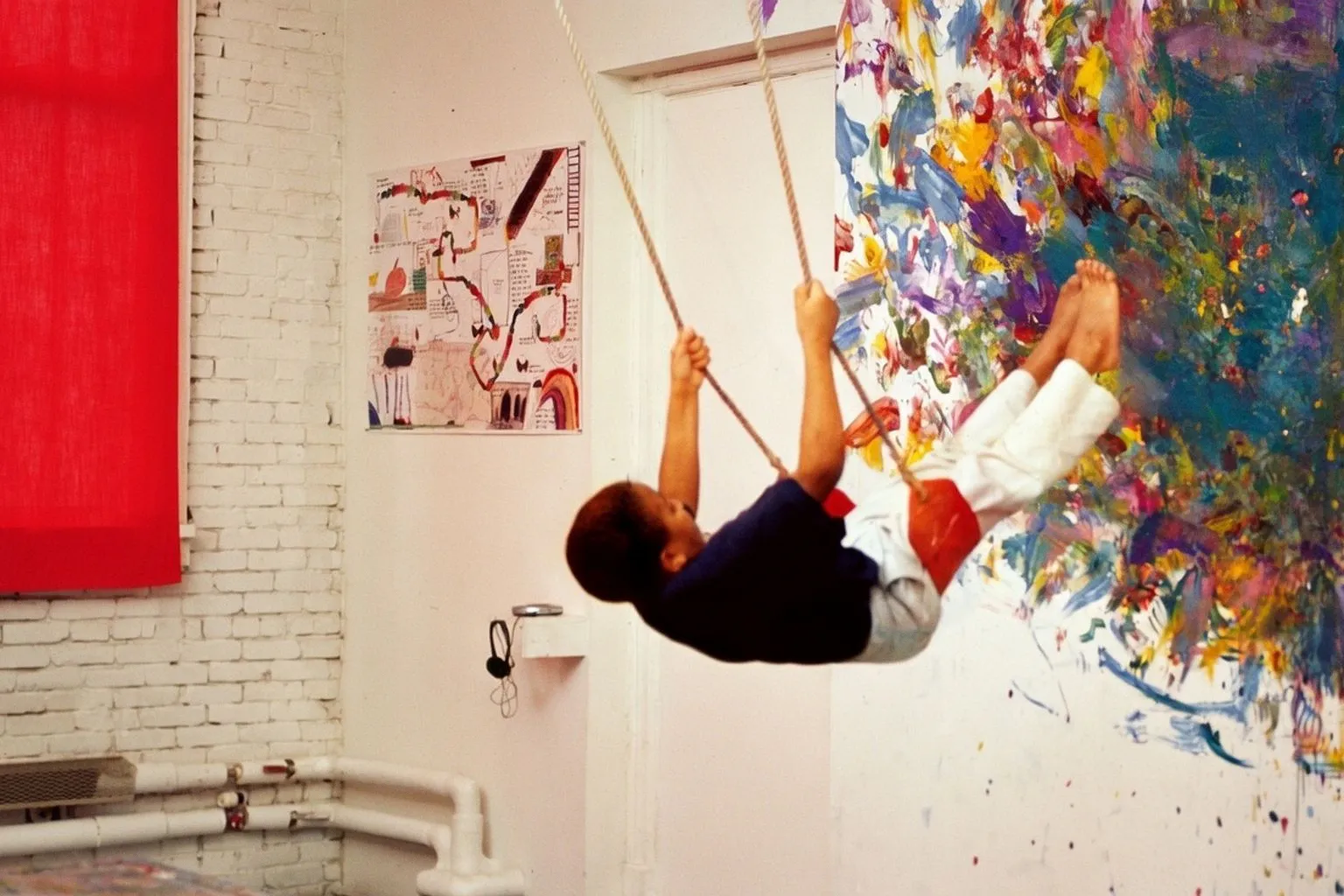
Pölten has opened FINALLY It’s HAPPENING, an exhibition focused on Carola Dertnig’s performative and painterly practices. It brings action painting, happenings and contemporary performance into one presentation. For painters, the useful question is how the exhibition makes bodily movement legible as a mark-making process.
From gesture to record
The exhibition draws on Dertnig’s Fly by Production, first presented at MoMA PS1 in 2000, according to the announcement. At KinderKunstLabor, the installation uses swings, a dance floor and a miniature golf course across the exhibition space. Visitors can apply colour to shoes, soles or textiles, then touch canvases mounted on the walls with their feet while swinging. The resulting imprints turn movement into a visible record.
That setup shifts the measure of a painted mark. Instead of controlling pressure and direction by hand, participants produce traces through momentum and contact. The announcement describes the work as combining sound, movement and functional sequences in an experience involving the whole body. It also notes that visitors can add fingerprints to part of a wall.
What painters can take from it
The technical point is not simply that bodies can be used as tools. Dertnig’s installation sets up a chain: movement generates contact; contact leaves pigment; repeated individual gestures accumulate into a shared surface. That makes the canvas less a site for a single composed image than a substrate registering actions.
The exhibition also places this method in relation to Viennese Actionism and action painting. According to e-flux, Dertnig approaches the historically male-coded gestures of those movements from a feminist perspective, recasting their association with shock and bodily violence as collective, welcoming participation. That framing matters: the same physical act can carry a different meaning depending on who controls the setup and how participation is structured.
For a studio test, the practical variables are straightforward: pigment transfer, surface durability, mark density and how much of the final image depends on each participant’s movement. The announcement does not provide material specifications or conservation details, so it cannot answer whether the process is reproducible outside the exhibition. But as a model, it offers a clear way to examine how gesture becomes notation—and how authorship changes when marks accumulate across many bodies.