Art workshop formats: finding the right path for your practice
You can spend a whole afternoon correcting a portrait and still end up with a face that feels less solid than the first loose sketch.
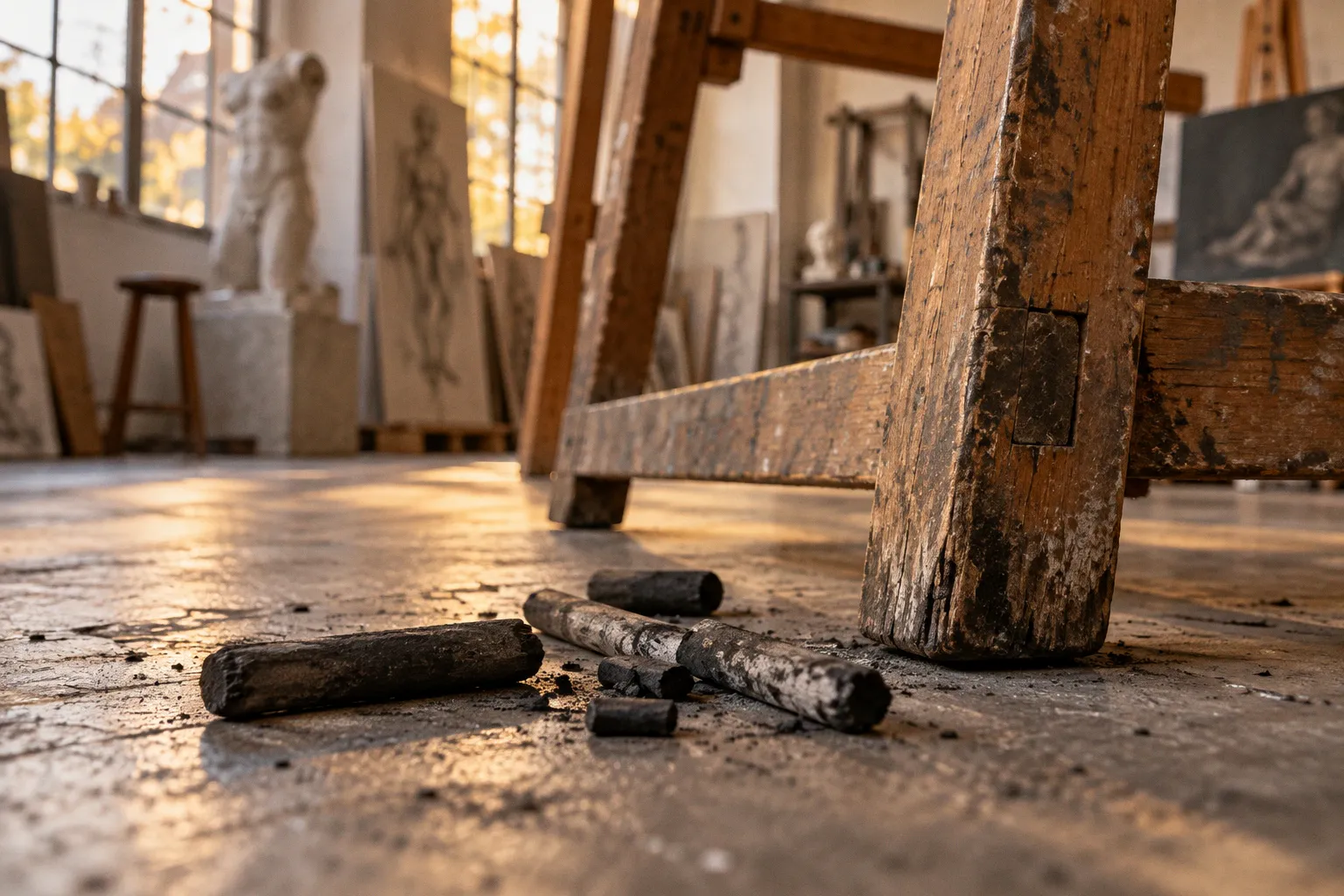
The proportions keep slipping; you push the shadows darker, then smudge them back into the light; the paint grows busy while the underlying problem stays put. When that happens, more instruction is not automatically the answer. The useful question is what kind of instruction gives you enough time, attention and structure to see the problem clearly.
Art workshop formats for professional development range from brief seminars to intensive academy courses, summer programmes, ongoing group classes and one-to-one studio coaching. Each can move a practice forward, but in a different way. A concentrated course may give you sustained time with a particular technique; a small group can make the act of looking less solitary; private teaching can bring the focus straight back to the decisions you are making on your own canvas. The right choice begins with the snag in your work, not the glamour of the course description.
Intensive courses: time to build a technical habit
A short workshop can introduce a method or sharpen a particular skill, but some problems need repeated attention before the new understanding becomes usable. If you are learning to construct a figure, control value relationships or handle oil paint without losing the shape beneath the brushwork, one demonstration may clarify the idea while leaving you to discover, alone, how it behaves in your own work.
That is where an intensive atelier course can be valuable. The Florence Academy of Art, for example, offers five-week workshops focused on classical figure drawing and oil-painting techniques. The significance of a five-week format is not simply that it is longer than a weekend. It gives the learning a sequence: you can make an attempt, receive a correction, try again, and begin to notice whether the same difficulty keeps returning.
This matters because painting errors often disguise themselves as other errors. A muddy skin tone may not be a colour problem at all; it may come from values that are too close together, or from warm and cool passages being blended until their edges lose purpose. A figure that feels out of proportion may need a clearer comparison of the large shapes before it needs another anatomical detail. With more time in the studio, you have a chance to return to those decisions instead of rushing past them toward a polished surface.
Before booking, look for evidence of how the course actually uses its time. A useful professional art workshop curriculum should make clear what participants will practise, what kind of feedback they can expect, and whether the schedule leaves room to apply that feedback. A long list of techniques is less revealing than a coherent progression from observation to making to review. Ask, too, whether the stated focus matches your present work: a course centred on classical figure drawing will not necessarily address the specific needs of an abstract painter or someone whose main question is how to develop a body of work.
A longer course is most useful when its structure gives you time to see a mistake, change one decision, and watch what that change does to the whole painting.
There is a practical trade-off. A five-week commitment asks for time away from other work and responsibilities, and an intensive schedule can leave little space for unrelated projects. The concentrated attention is the point, but it is not a substitute for knowing what you want to concentrate on. Arrive with a question you can carry from one session to the next: not “How do I become a better painter?” but “What keeps making my figures feel flat?” or “How can I separate the light planes without outlining every form?”
Summer academies: concentrated work among peers
A summer academy often sits between the compact workshop and the longer commitment of a regular studio course. The Salzburg International Summer Academy of Fine Arts offers intensive workshops lasting two to three weeks, with approximately 15 participants per course. Its workshops take place across locations that include Hohensalzburg Fortress and Untersberg Quarry.
The cohort size gives a useful sense of the setting, though a number on its own cannot tell you how much individual attention each participant receives. A group of around 15 can support conversation and make it possible to learn by watching how others approach a shared problem. It also means that feedback is necessarily distributed. If you want repeated, close critique of one specific painting, ask how teaching time is organised rather than assuming that a small-sounding group guarantees private instruction.
Group learning has a particular strength: it lets you compare visual decisions. One person may simplify a shadow mass; another may keep more of the shifting edges. When you look at the results side by side, you begin to understand that a problem can have more than one workable answer. This can loosen habits that feel like rules simply because you have followed them for a long time.
At the same time, peer learning asks you to stay actively involved. You are not only waiting for the instructor to diagnose your canvas; you are practising the work of looking, describing and making sense of what has changed. That can be uncomfortable, especially when a painting is unfinished and you would rather conceal the uncertain passage. But learning to name what you see is part of learning to revise it.
An intensive summer course is most likely to suit you if you want a defined stretch of focused work, are comfortable learning in a group, and can make use of the atmosphere of shared practice. If you need detailed guidance tailored to the structure of an existing body of work, the course’s subject and teaching approach matter more than its location or reputation. Before choosing, try to find out:
- how the instructor balances demonstrations, individual work and critique;
- whether the course welcomes your level of experience and medium;
- what materials or preparatory work are expected;
- how many participants are in the actual teaching group, not merely the wider programme;
- whether the stated outcome is technical practice, exploration, portfolio development or something else.
A two- or three-week academy can change the rhythm of your work, but the real test comes later, when you are back in your own studio. Choose a programme that offers a process you can continue, not only a memorable stretch of concentrated activity.
When the practice needs more than paint
Professional development is not always a matter of pushing values or finding a cleaner edge. Many artists reach a point where the work itself is developing, but the practical conditions around it are fragile: pricing feels arbitrary, applications are difficult to organise, or the business side of a practice keeps being postponed until the next quiet week.
For that kind of need, a technical painting course may be the wrong instrument. Springboard for the Arts developed its Work of Art: Business Skills for Artists curriculum around practical career subjects including pricing work, marketing, legal considerations and business development. Workshops offered by organisations such as the Riverside Arts Council address areas including grant writing, public speaking, portfolio development, taxes and residencies.
These subjects can sound far removed from the easel, but they shape whether a practice can continue. A beautifully resolved painting does not automatically come with a clear price, a well-prepared portfolio or a workable plan for an application. If those are the points where you are losing momentum, a career-focused workshop may answer a more urgent question than another masterclass in technique.
The format should still be examined with the same care you would bring to a painting course. Does it offer a usable method, or only a broad overview? Will you leave with a draft budget, a revised portfolio, a clearer pricing approach or a plan for a particular application? A workshop cannot promise that a grant will be awarded or that sales will follow, and there are no reliable universal figures showing that one format produces a particular career outcome. Its value lies in helping you make the next practical decision with more clarity.
Some programmes combine studio practice with professional skills; others keep these areas separate. Neither arrangement is automatically better. If you are at a stage where business decisions are preventing you from making or showing work, career training may unlock time and attention. If your main difficulty is visual, a business curriculum will not resolve the drawing beneath a portrait. It is worth being exact about which kind of friction you are trying to remove.
Group instruction or private studio coaching?
The choice between group and private painting instruction is not a test of seriousness. It is a decision about what kind of attention your work needs. In a group, you benefit from shared demonstrations and other people’s questions; in one-to-one coaching, the lesson can follow the particular canvas, technique or decision in front of you.
| Format | What it can offer | What to clarify before booking |
|---|---|---|
| Group workshop | Shared demonstrations, peer observation and discussion across different approaches | How critique time is divided, and whether the group’s level and focus suit your work |
| Individual studio coaching | Attention directed toward your own work and immediate questions | How lessons are structured, what preparation is expected, and whether the teaching supports independent decisions |
| Online module or lesson | Access to instruction without travelling to a studio | How feedback works, whether you can submit work, and whether the material includes demonstrations you can revisit |
| Ongoing mentorship | Repeated guidance as projects and questions develop | How often you meet, what happens between sessions, and how progress is reviewed |
One of the benefits of individual art coaching is that you can bring the real problem rather than adapt yourself to a general exercise. If your still life keeps flattening, a teacher can help you look at the arrangement, value structure and edges in the painting you are actually making. If a portfolio feels inconsistent, a conversation can focus on how the selected works relate to one another. The attention is personal; that does not mean the teacher should take over the work or prescribe a single correct style.
Private instruction also has limits. A teacher may be able to see a proportion problem quickly, but you still need to learn how to spot it yourself the next time. The most useful lesson makes the process of looking more available to you: comparing angles, checking large shapes, separating value families, and deciding where an edge needs to sharpen or soften. If every decision depends on the instructor’s approval, the coaching has not yet become a practice you can carry alone.
A group can offer a different kind of independence. You learn to watch, listen and make choices without having the instructor beside your easel at every turn. You may also discover that the question you thought was uniquely yours—how to keep a drawing from stiffening, or how to stop blending a passage into grey—is shared by other painters. There is relief in that recognition, but there is also useful evidence: you can observe several solutions rather than copying one answer.
Ask prospective teachers how critique works in practice. Does feedback focus on the work’s stated aims, or does it pull every painting toward the instructor’s preferences? Do you receive a specific next step, or only a general impression? Does the format allow you to make revisions and return to them? These questions matter in both private lessons and group settings. Warm encouragement is valuable, but encouragement without clear looking rarely changes what happens at the easel.
Short seminars, long mentorships and the work between them
The contrast between intensive atelier courses and weekend workshops is often described as a choice between depth and convenience. That is too simple. A weekend seminar can be exactly right when the goal is narrow: an introduction to a material, a focused drawing exercise, or a first encounter with an unfamiliar approach. It is less suited to a problem that needs sustained observation and repeated correction.
Long-term mentorship, in turn, is not automatically more profound because it lasts longer. Its strength is continuity. A mentor can follow how a series changes, notice recurring habits and help you make decisions across several projects rather than in one isolated session. But continuity only helps when the meetings have a purpose and leave room for your own work between them. Otherwise, regular contact can become a comfortable conversation that never quite reaches the canvas.
A useful way to compare formats is to write down the next change you want to make in your practice, then ask how each option would help you make it. If you need to draw the figure more accurately, look for direct drawing time and feedback on structure. If you want to loosen your handling of paint, a demonstration followed by sustained painting may matter more than a lecture. If you are building a portfolio, you may need selection and sequencing guidance rather than another exercise in technique.
The duration should follow the task, not the other way around. A narrow question may be served by a short seminar. A technique that keeps collapsing under pressure may need a longer course in which you can practise, receive feedback and practise again. A body of work that is shifting over months may call for mentorship or a series of studio sessions. None of these formats can guarantee artistic or career growth, and no single choice suits every discipline or stage of practice.
When comparing programmes, read the teaching plan as carefully as the title. Words such as “masterclass,” “intensive” and “advanced” do not tell you what happens when a painting goes wrong. Look for the practical route through the course: what you will make, how the instructor will respond, and whether you can take the learning back to your regular studio work. Where those details are missing, ask before you commit.
Choose the format that brings your real difficulty into view, then gives you enough room to work on it.
We have all been tempted by a course because it sounds like the version of ourselves we hope to become: more disciplined, more fluent, finally confident with the figure or with oil paint. That hope can be useful, but it is not a teaching plan. The more dependable starting point is the work already in front of you—the passage that keeps muddying, the drawing that will not hold, the portfolio you cannot edit, the practical task you keep avoiding. Name that problem plainly. Then choose the workshop, group, coach or mentor whose way of working can help you meet it, patiently and with your own hand still on the brush.