Solo exhibition planning: essential steps for a debut show
Most artists treat their first solo show like a party they throw overnight and then wonder why half the guests didn't show up.
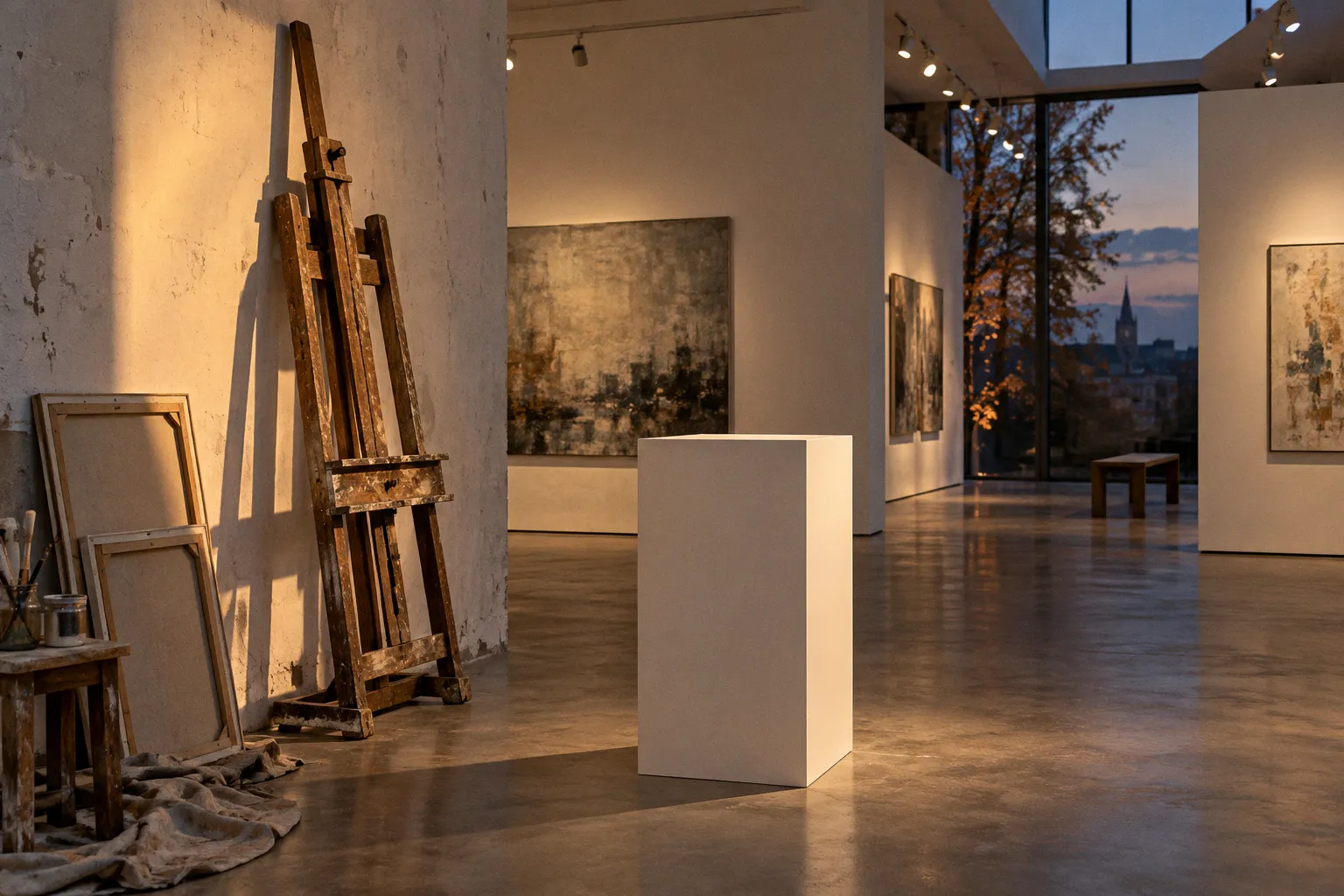
The reality is simple and uncomfortable: a debut solo exhibition runs on a six-to-twelve-month clock, longer if you're targeting a proper gallery, shorter only if you're staging a DIY project in a borrowed room with the work already in hand. Anyone telling you otherwise is selling you something — usually themselves as a "mentor" with a course. The professional path runs backwards from the vernissage date. Lock the opening, mark every milestone between now and then on a calendar, and execute to the schedule. Skip the schedule and your debut becomes a private viewing with your mum.
The timeline isn't arbitrary. Gallerists program their calendars twelve to twenty-four months out. Print houses need six to eight weeks for invitations. Art editors work two to three months ahead of publication. If you want a debut to land inside the cultural conversation instead of at the bottom of a journalist's inbox, you start now — not when the idea arrives, but months before you finish the work.
The 12-Month Roadmap: From Concept to Vernissage
The cleanest way to plan a debut show is in reverse. Pick your opening date, then walk backward through the milestones. Industry-standard lead time for a major exhibition is six to twelve months, and that range is on the optimistic end — blue-chip commercial galleries and Kunstvereine with curated programs often schedule programming one to two years in advance. Pitching a serious venue in March for a September opening means you've already missed the programming meeting.
For smaller self-organized shows in project spaces, Kunstvereine without waiting lists, or curated cafés, three to six months is workable — but only if the body of work, the documentation, and the venue agreement are already locked in before you start the clock. Compressing the timeline never compresses the workload. It just moves the same labor into fewer nights and more caffeine.
Milestones stack like this:
| Months out | Milestone | Why it matters |
|---|---|---|
| 12–9 | Concept locked, body of work underway, venue shortlist | Defines what you're showing and what kind of room it needs |
| 9–6 | Signed venue agreement, budget reconciliation, framing specs | Locks the floor plan and financial exposure |
| 6–3 | High-resolution artwork photography, wall texts, catalogue copy | Marketing collateral can't exist without images |
| 3–1 | Print invitations, press release distribution, media outreach | Print runs and editorial calendars lead time |
| 1–0 | Social campaign rollout, final install, opening logistics | Where most debuts collapse under accumulated debt |
Treating the final month as the only month is the rookie move. The final month is just the month where everything you skipped in the previous eleven shows up simultaneously and demands your attention.
Securing the Space: Navigating Contracts and Venue Logistics
The venue conversation is where optimism meets paperwork. For any non-studio location — gallery, Kunstverein, project space, café with curatorial pretensions — you need a written agreement. Not a handshake, not a vibe, not a DM. A signed contract or letter of agreement that spells out the terms in plain language both parties understand.
The clauses that should be in writing, in roughly this order:
1. Commission structure — rate, split, when it's triggered, and what gets excluded (edition sales vs. originals, sales during the run vs. post-show referrals).
2. Sales administration — who handles invoicing, who takes payment, who signs the certificate of authenticity, and how funds reach you after the run.
3. Hanging method — picture rails, hooks, nails, mounting tape, security hardware. Some venues have firm rules; non-compliance becomes your problem on install day.
4. Lighting — what's installed natively in the room, what gets added, who's paying for it, and who adjusts it if the work looks wrong.
5. Insurance — public liability coverage for opening night, plus artwork insurance during transit and the full run. Whose policy, what the deductible looks like, and who files the claim if anything goes sideways.
6. Duration and access — exact install and deinstall dates, exact opening and closing, and what hours you can access the room for final adjustments.
7. Post-show handling — what happens to unsold work, who stores it, for how long, and at what cost.
If a venue resists putting any of this in writing, that is your answer. Walk. Debris halls with curatorial pretensions have been fleecing debut artists for decades, and paper is the only vaccine.
Beyond the contract, walk the room with a tape measure before committing. Ceiling height, natural light orientation, floor finish, wall material (drywall and concrete behave very differently for hanging), and outlet placement all affect what's possible. A space that looks romantic in someone else's press shots can be a logistical nightmare in person. Bring a critical friend with no emotional stake in your ego.
Curating the Narrative: Spatial Flow and Artwork Placement
Curation is not magic. It is a floor plan and a sequence. Decide which piece anchors the entrance and which work you want viewers carrying home in their memory. Everything in between is connective tissue.
A few working rules that survive most debuts:
- Anchor pieces belong opposite the entry or on the longest uninterrupted wall — not dead-center where they look stranded, not in corners where light fails.
- Breathing room matters. Fifteen to twenty centimeters between works on a shared wall is a starting floor; large-format pieces usually want more.
- Sight lines should not give the whole show away from the doorway. Use partial partitions, angled walls, or strategic occlusion to make viewers move through the room.
- Rotate scale, surface, and palette so the eye rests. Three large oils in identical frames in a row is a slog, not a statement.
The curator's quiet confession: a properly hung show feels inevitable in retrospect. It looks like the works always belonged there. Achieving that feeling takes more floor-plan sketches, painter's-tape mockups, and revised hanging lists than most artists will ever admit to in public.
Professional Documentation and Marketing Assets
Three to six months before opening you need professional images of every piece that will hang. Not phone snapshots in raking light — high-resolution, color-accurate photography on a neutral background, ideally shot by someone who has photographed for galleries before and understands how reproductions print. These images are the raw material for:
- Wall labels and didactic panels
- Press release images in correct aspect ratios
- Online catalogue pages and gallery website listings
- Social media content throughout the campaign
- Submission packets for reviews, awards, and future applications
If you shoot in March for an October show, you have six months to feed those images into every promotional channel. If you shoot in September, you have nothing to send the journalist who emails you in week two of the run.
Print and digital lead times that bite first-time exhibitors:
- Invitations and postcards: six to eight weeks for design, print, and delivery. Plan the mailing list before this goes to press.
- Press release: distribute four to six weeks before opening, with a follow-up two weeks out. Editors need lead time almost as much as printers do.
- Social media: build-up content should begin at least one month before opening night. Single-post-and-pray has never sold a show.
- Email newsletter: two sends — a save-the-date at the start of the campaign and a final-week reminder with installation shots.
The ratio that actually matters is unglamorous: how many eyeballs you reach before opening versus how many walk through the door. Most debut shows plateau at the artist's existing network. Planning the outreach before the work is finished is what expands that network beyond friends and family.
Budgeting for the Essentials: Beyond the Canvas
Budgets for debut shows vary so widely by city, venue, and ambition that quoting fixed numbers is misleading. What matters is knowing every line item so nothing blindsides you in the final month.
Core cost categories, in the order they're usually incurred:
- Venue rental or commission agreement — the single largest line, and the one that determines whether the show is financially viable at all.
- Framing and presentation hardware — varies enormously by size, material, profile, and finish. A suite of identically framed works is the cheapest path; mixed framing is the most expensive.
- Transport and shipping — including professional art handlers for anything you cannot safely move yourself.
- Insurance — public liability for opening night, transit coverage, and exhibition coverage for the run. Three separate policies in some cases.
- High-resolution photography — a single day's shoot that determines the quality of every image the public will ever see of this body of work.
- Print collateral — invitations, postcards, wall labels, didactic panels, catalogue if applicable, install diagrams.
- Opening reception — wine, water, glassware, napkins, someone hired to pour. Underestimating this line is how debuts go over budget.
The categories debut artists routinely forget: audio-visual equipment for any talk or screening, travel and accommodation for out-of-town curators or press, sales-tax compliance and invoicing infrastructure if anything sells, backup framing or hardware if the venue's stock doesn't match the work, and post-show storage if unsold pieces don't go home immediately.
Build the budget at the same moment you sign the venue. If the numbers don't reconcile, you find out before you've committed to a show you can't afford to produce properly.
A first solo show is a logistics exercise disguised as an artistic one. The artists who debut well aren't the ones with the best concepts — they're the ones who hit their milestones and their shipping deadlines while still having bandwidth left for the work.
Plan the show like a project and the opening becomes what it should be: a room full of people, hung work that holds the room, and you breathing normally for the first time in a year. That's the debut worth having.